
How to Read a Sapphire Certificate
A sapphire certificate is an independent laboratory's report on what a stone is: its identity, weight, treatment and, often, an opinion on origin. It confirms the facts a seller's word cannot. It is not a valuation, and it does not set the price.
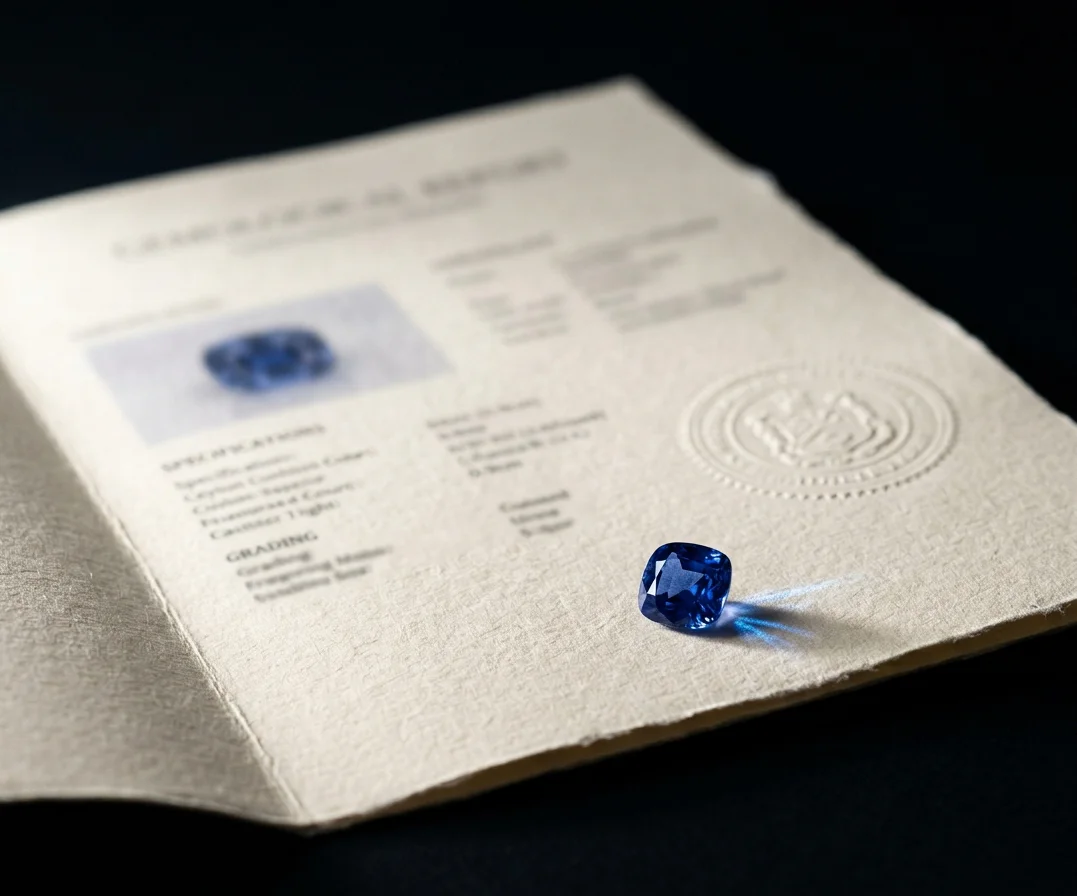
What Does a Sapphire Certificate Prove?
It proves the stone's identity, its weight and measurements, and its treatment status, and it usually gives an opinion on origin.
The single most important thing a report confirms is that the stone is a natural sapphire, not a synthetic, laboratory grown one, a simulant such as glass, or a different gem altogether. It also records the exact weight in carats, the measurements in millimetres, the shape and cut, and a description of the colour. For a coloured stone the treatment line is critical: it states whether the sapphire has been heated.
Many reports go further and give an origin opinion, naming the country the stone most likely came from. Taken together, these are the facts that decide what you are actually buying, and they come from a laboratory with no stake in the sale.
How to Read a Report, Line by Line
Laboratories lay the page out differently, but the same lines are always there. Read them in this order, from the number you verify it by to the two lines that decide the most: treatment and origin.
- 1 Number and date Note them first. You will use the report number to verify the document at source later.
- 2 Identification It should read natural sapphire or natural corundum, confirming the stone is not synthetic or a simulant.
- 3 Weight and measurements The carat weight and the millimetre dimensions, which must match the stone in your hand exactly.
- 4 Colour, shape and cut A neutral description of the body colour and the stone's cutting style, not a judgement of beauty.
- 5 Treatment Heated, or no indications of heating. This is the line that supports an unheated premium, so read it before the price.
- 6 Origin The laboratory's expert opinion of country, such as Ceylon. Give it more weight from a respected lab.
the issuing laboratory
What Do the Origin and Treatment Lines Mean?
The origin line names the stone's likely country of origin as an opinion. The treatment line states whether it has been heated.
An origin line such as Sri Lanka (Ceylon) is the laboratory's opinion of where the stone formed, reached by studying its inclusions, trace elements and spectra. Ceylon is a sought-after origin, which is why this line carries a premium when a respected lab documents it.
The treatment line is where you confirm heat. Wording varies: a heated stone may be described simply as heated, while an unheated stone is often given as no indications of heating. If you are paying an unheated premium, this is the line that justifies it. Our guide to heated and unheated sapphire explains what is at stake.

A Report Tells You What a Stone Is, Not What It Is Worth
A gemmological report is not an appraisal. It will not tell you the price, and an origin line is an expert opinion, not an absolute certainty. Be wary of any certificate that prints a value, because that is a sales tool, not an independent fact.
What Does a Certificate Not Prove?
It is not a valuation, and an origin opinion is not a guarantee. It describes the stone; it does not price it or rate its beauty.
Two limits matter. First, a gemmological report is not an appraisal. It will not tell you what the stone is worth: price is set by the market and by quality, and a valuation is a separate document. Be wary of any certificate that prints a value, because that is a sales tool, not an independent fact.
Second, origin is an expert opinion based on the stone's inclusions and chemistry, not an absolute certainty. The best laboratories are highly reliable, but they can occasionally reach different conclusions on the same stone, and some material is simply harder to call. Read origin as a well-founded opinion, and give it more weight when it comes from a respected lab.
Who Issues Sapphire Reports?
| Laboratory | Based in | Reputation |
|---|---|---|
| GIA | United States | Widely recognised identification, weight and treatment; origin available |
| SSEF | Switzerland | Respected origin and treatment opinions, especially for fine stones |
| Gübelin | Switzerland | Respected origin and treatment, with detailed research |
| GRS | Switzerland and Asia | Detailed colour and origin calls, common in the coloured-stone trade |
How Do I Verify a Certificate Is Genuine?
Verify the report number on the laboratory's own website, and check that the stone matches the report's weight, measurements and photograph.
Most respected laboratories let you confirm a report online by entering its number, and many show the report's details or a photograph. Always do this yourself rather than trusting a scan, because a document can be edited, or a real report can be paired with a different stone. The weight and measurements on the report should match the stone exactly.
Be cautious with reports from unfamiliar laboratories, with photocopies that cannot be verified, and with any stone whose seller is reluctant to let you check. A genuine fine sapphire from an honest seller comes with a report you can confirm at source. If you are also screening for fakes, see our guide to spotting a fake Ceylon sapphire.
- What it is
- An independent gemmological report
- Identity
- Natural sapphire, confirmed
- Treatment
- Heated, or no indications of heating
- Origin
- An expert opinion, not a certainty
- Verify at
- The issuing laboratory's website
- Not
- A valuation or a price
Common Questions
GIA is one of the most widely recognised laboratories and its reports are trusted worldwide. For fine coloured stones, SSEF and Gübelin are especially respected for origin and treatment, and GRS is common in the trade. The best report is one from a respected, independent laboratory that you can verify; the right choice depends on the stone.
No. A gemmological report describes the stone but does not price it. Value comes from the market and from quality. A document that prints a value is a valuation or a sales tool, not an independent gemmological report.
Origin is an expert opinion, not an absolute fact. Respected laboratories are highly reliable, but they can occasionally differ on the same stone, and some material is hard to call. Give the most weight to origin opinions from well regarded labs.
It is how many laboratories state that they found no evidence the sapphire has been heated, in other words that it is unheated. It is the line that supports an unheated stone's premium, so check it carefully if that is what you are paying for.
Enter the report number on the issuing laboratory's official website, which most respected labs provide. Confirm the details and any photograph match the stone, and check that the weight and measurements are identical. If a report cannot be verified at source, treat it with caution.
Learn More
Want the Report Before You Decide?
Ask us for the laboratory report on any stone, and we will send it so you can verify it yourself before you commit.